Karl Storz endoscope - Main applications
The main application of a rodent customized Karl Storrz endoscopic system is minimally invasive, real-time visualization and intervention within the internal organs of small animal models. Designed to navigate the compact anatomy of rodents, these systems enable high-resolution imaging and precision access to gastrointestinal, thoracic, reproductive, and joint structures. Their compatibility with CO₂ insufflation, irrigation, and advanced light sources (including far-red fluorescence) makes them especially valuable for diagnostic procedures, targeted biopsies, intra-tissular drug delivery, and longitudinal disease monitoring. By reducing surgical trauma and enabling repeated interventions on the same subject, rodent endoscopy supports refined, ethically sound, and cost-effective preclinical research across a wide range of biomedical fields.
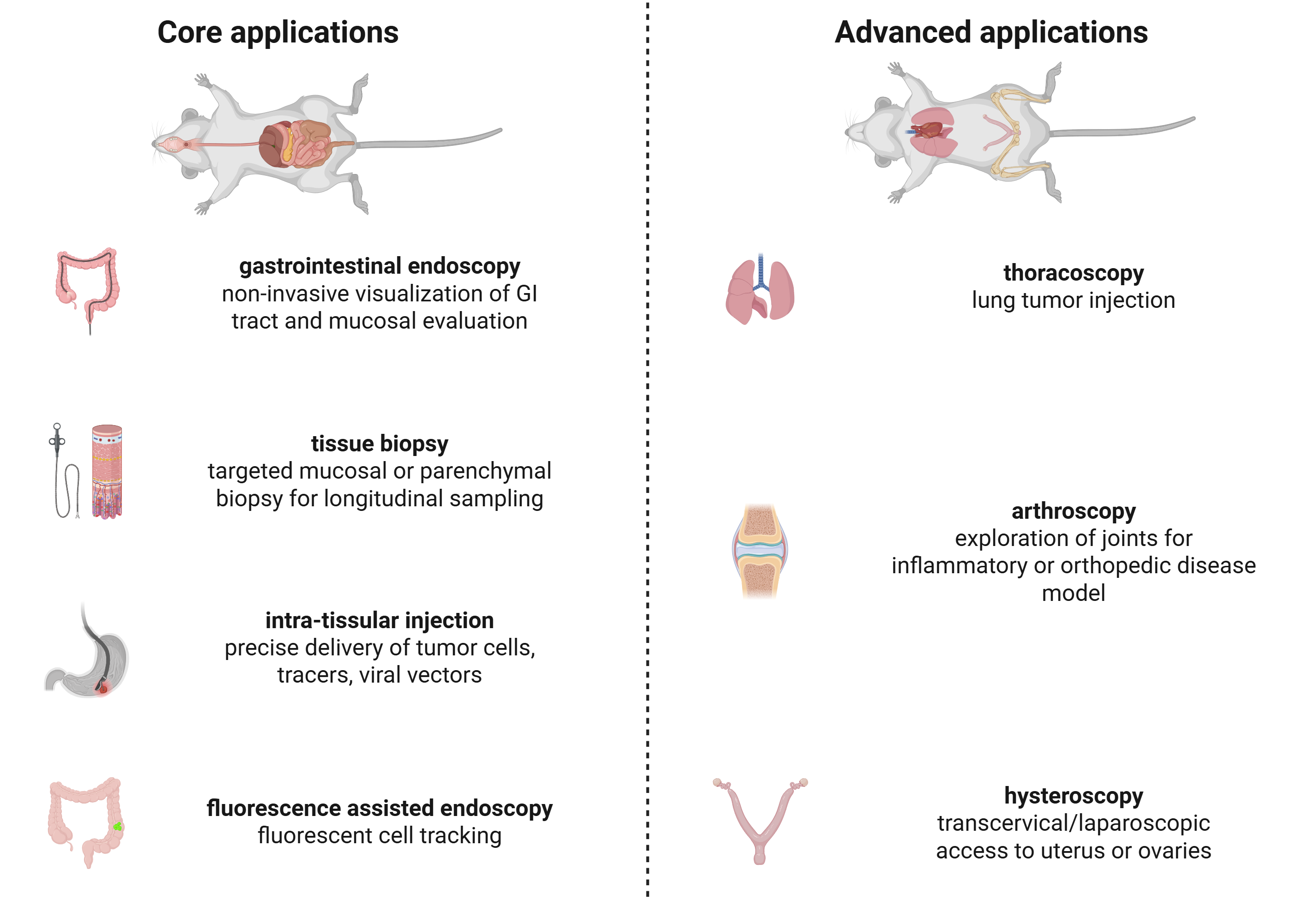
Common applications of rodent endoscopy
Core applications
These applications are regularly implemented using small-diameter rigid or semi-flexible veterinary endoscopes (typically 1.9–3.0 mm outer diameter), and do not require extreme modifications.
- Gastrointestinal endoscopy
Gastroscopy: visualizing esophagus, stomach, and proximal duodenum to study ulcers, tumors, inflammation
Colonoscopy: IBD models, tumor tracking, microbiome-gut barrier investigations
- Tissue biopsy
Endoscopic-guided mucosal or superficial tissue sampling (intestinal or liver surface biopsies)
Minimally invasive and suitable for serial biopsies in the same animal
- Intra-tissular injection
Direct delivery of tumor cells, drugs, or fluorescent tracers into specific GI or peritoneal sites under visual guidance
Common in orthotopic tumor model creation or targeted delivery experiments
- Endoscopic-assisted fluorescence imaging
White light and far-red modes for ICG-based perfusion or lymphatic imaging
Confirmation of vascular supply or drug deposition at injection sites
Specialized/Experimental applications
These require custom-built endoscopes, modified surgical techniques, and specialized lab setups. They are rarely routine, but have been demonstrated in specialized research environments.
Thoracoscopy: direct entry into the thoracic cavity to inspect lungs or heart surface, for lung tumor injection/biopsy orleural delivery of agents
Hysteroscopy: transcervical/laparoscopic access to uterus or ovaries for fertility studies, embryo transfer, or reproductive tumor modeling
Arthroscopy: exploration of small joints for inflammatory or orthopedic disease models