nVue-nVision - Main applications
The nVue miniscope platform is designed to enable minimally invasive, longitudinal, cellular-resolution imaging in freely behaving animals paired with synchronized behavioral tracking, for precise spatio-temporal mapping of local brain activity in relation to behavior.
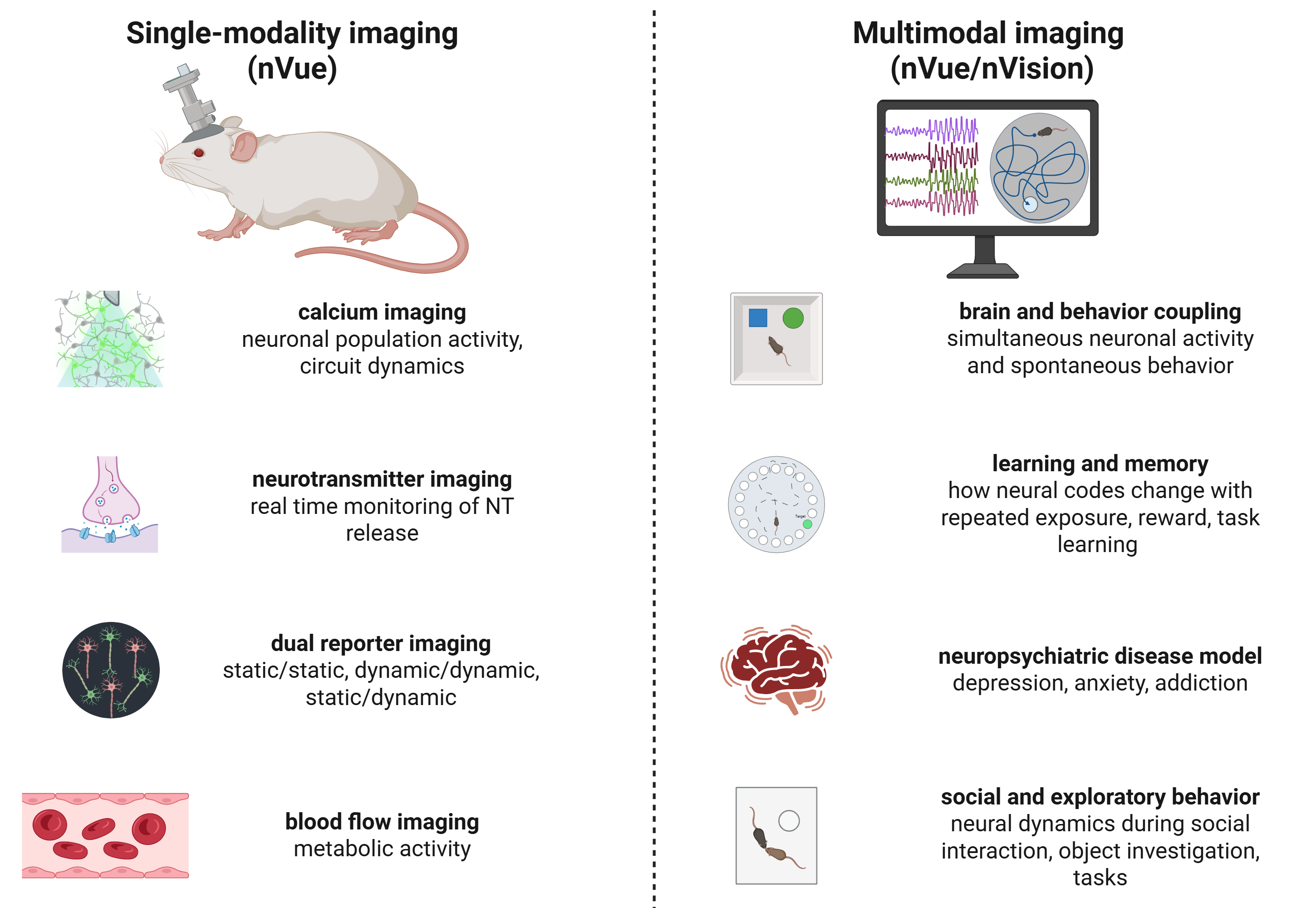
Common applications of miniscope imaging
Single modality imaging (nVue)
- Calcium imaging (GCamp, RCamp)
Enables optical detection of action potential-associated intracellular Ca²⁺ transients.
Captures population-level activity from excitatory or inhibitory neurons.
Applied in studies of cortical and subcortical circuit function during task performance, rest, or spontaneous activity.
- Neurotransmitter imaging (dLight, GRAB, iGluSnFR)
Measures extracellular neurotransmitter dynamics such as dopamine, glutamate, serotonin, or acetylcholine in real time.
Useful for studying neuromodulatory control of motivation, reinforcement, attention, and emotional state.
Applied in pharmacological studies and addiction research.
- Dual-signal imaging
Simultaneous recording of neural activity and/or neuromodulatory signals using spectrally distinct fluorescent indicators.
Allows dissection of causal relationships between neurotransmitter release and downstream circuit responses.
Ideal for multi-population or multi-pathway functional mapping within the same brain region.
Allows for static/static, static/dynamic and dynamic/dynamic recordings.
- Longitudinal neural ensemble tracking
Supports stable, chronic recordings from the same neuronal population across days or weeks.
Enables investigation of learning-related plasticity, disease progression, and memory consolidation.
Facilitates studies of neuronal identity retention, population coding dynamics, and circuit adaptation.
- Cerebral blood flow imaging
Investigates vascular responses to circuit activation.
Studies of neurovascular impairment in aging, stroke, or models of neurodegenerative diseases.
Evaluates metabolic load and vascular plasticity in learning or disease contexts.
Multimodal imaging (nVue + nVision)
The synchronization of both nVue and nVision cameras enable the real time combination of neuronal signal imaging with behavior.
- Brain-behavior coupling
Enables real-time correlation between neuronal ensemble dynamics and specific motor, cognitive, or emotional behaviors.
Critical for identifying functional neural correlates of decision-making, navigation, or social interaction.
Provides high temporal resolution synchronization of neural and behavioral data streams.
- Learning and memory encoding
Tracks how ensemble activity evolves across repeated exposure to environmental stimuli or operant tasks.
Used to reveal circuit-level mechanisms of learning phases (acquisition, consolidation, extinction).
Supports causal inference in behavior-driven plasticity through repeated exposure paradigms.
- Neuropsychiatric and neurological disease models
Enables quantitative phenotyping of circuit dysfunction in models of depression, PTSD, anxiety, addiction, Alzheimer’s, and Parkinson’s disease…
Allows evaluation of therapeutic interventions (pharmacologic, genetic) on both behavior and brain function.
Ideal for longitudinal biomarker discovery at the level of cellular networks.
- Social and ethologically relevant behaviors
Permits imaging during unrestrained behaviors such as social investigation, aggression, parental care, or environmental exploration.
Supports analysis of circuits involved in emotional valence, threat response, or affiliative behavior.
Especially relevant in translational studies of neurodevelopmental or affective disorders.